Difference Between BDD and TDD
Difference Between BDD and TDD
In modern software development, testing plays a critical role in delivering high-quality applications.
Two widely used development approaches that integrate testing early in the development lifecycle are
Test Driven Development (TDD) and Behavior Driven Development (BDD).
Both approaches encourage writing tests before writing the actual code, but they differ in purpose,
focus, and communication style.
Understanding the difference between BDD and TDD helps software testers, developers, and product teams collaborate effectively and ensure that applications behave as expected from both technical and
business perspectives.
What is Test Driven Development (TDD)?
Test Driven Development (TDD) is a software development methodology where developers
write automated unit tests before writing the actual application code. The goal is to ensure that the
code is written only to satisfy the test cases and that each unit of functionality is verified early.
TDD follows a simple cycle often referred to as the Red-Green-Refactor cycle:
- Red – Write a failing test that defines a desired function.
- Green – Write the minimal code required to make the test pass.
- Refactor – Improve the code while keeping the tests passing.
TDD primarily focuses on code correctness and developer productivity. It ensures that
each small piece of code works properly before moving forward.
What is Behavior Driven Development (BDD)?
Behavior Driven Development (BDD) is an extension of TDD that focuses on the
behavior of the application from the user’s perspective. BDD encourages collaboration
between developers, testers, and business stakeholders to define application behavior using
human-readable language.
BDD scenarios are usually written using the Given-When-Then format:
- Given – The initial context or precondition.
- When – The action performed by the user.
- Then – The expected outcome or system behavior.
These scenarios are often written using tools such as Cucumber, SpecFlow, or Behave,
which allow automated tests to be generated from readable specifications. This approach ensures that
the application behavior aligns with business requirements.
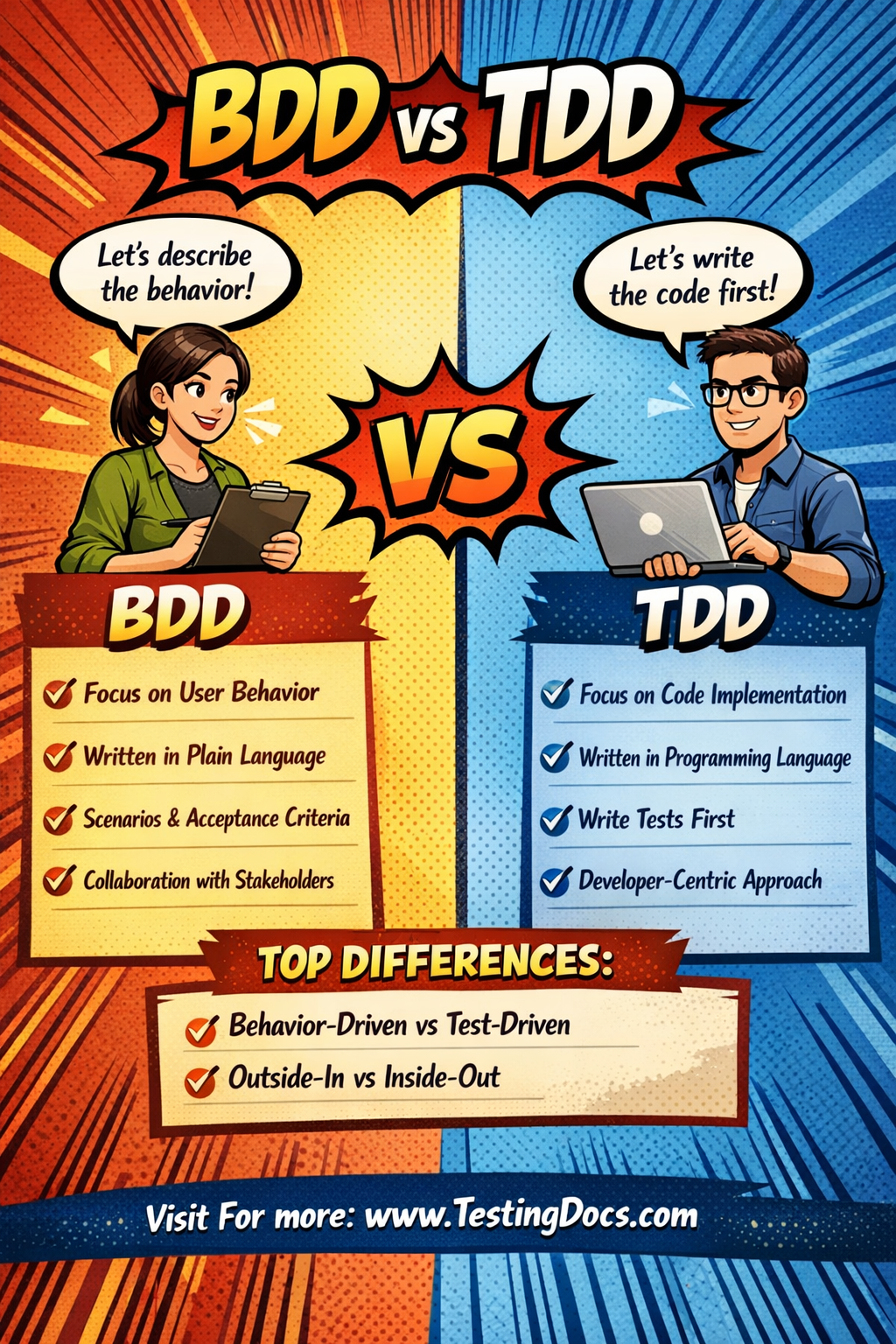
BDD vs TDD
Although both methodologies encourage writing tests before implementation, their objectives and
audience differ. The following table highlights the major differences between BDD and TDD.
| BDD (Behavior Driven Development) | TDD (Test Driven Development) | |
|---|---|---|
| Main Focus | Focuses on application behavior from the user’s perspective. | Focuses on verifying individual units of code. |
| Audience | Developers, testers, and business stakeholders. | Primarily developers. |
| Language Used | Uses natural language scenarios (Given-When-Then). | Uses programming language test cases. |
| Purpose | Ensures the system behaves according to business requirements. | Ensures code works correctly at the unit level. |
| Test Style | Scenario-based acceptance tests. | Unit tests written before code implementation. |
| Common Tools | Cucumber, SpecFlow, Behave. | JUnit, NUnit, TestNG. |
| Collaboration Level | High collaboration between technical and non-technical teams. | Mostly developer-centric. |
Both TDD and BDD promote writing tests early in the development
process and help improve software quality. TDD focuses on building reliable code through unit tests,
while BDD ensures that the application behavior aligns with business expectations and user needs.
For software testers, understanding both approaches is highly valuable. TDD helps in validating code
logic, while BDD improves collaboration and ensures that the product delivers the intended behavior.
Using both practices together can significantly enhance test coverage, communication, and overall
software quality.