Perplexity Computer
Perplexity Computer
Artificial Intelligence is evolving rapidly, and one of the interesting concepts gaining attention is Perplexity Computer. If you are new to AI systems and intelligent automation, this guide will help you understand what it is, how it works, and why it matters.
What is Perplexity Computer?
Perplexity Computer is an AI-powered system designed to process, analyze, and generate intelligent responses by combining multiple AI models and computational strategies. Instead of relying on a single model, it leverages various AI engines to improve accuracy, reasoning, and contextual understanding.
Perplexity Computer is an end-to-end AI agent that is built on 19 models simultaneously. It is capable of running projects autonomously inside a secure cloud sandbox.
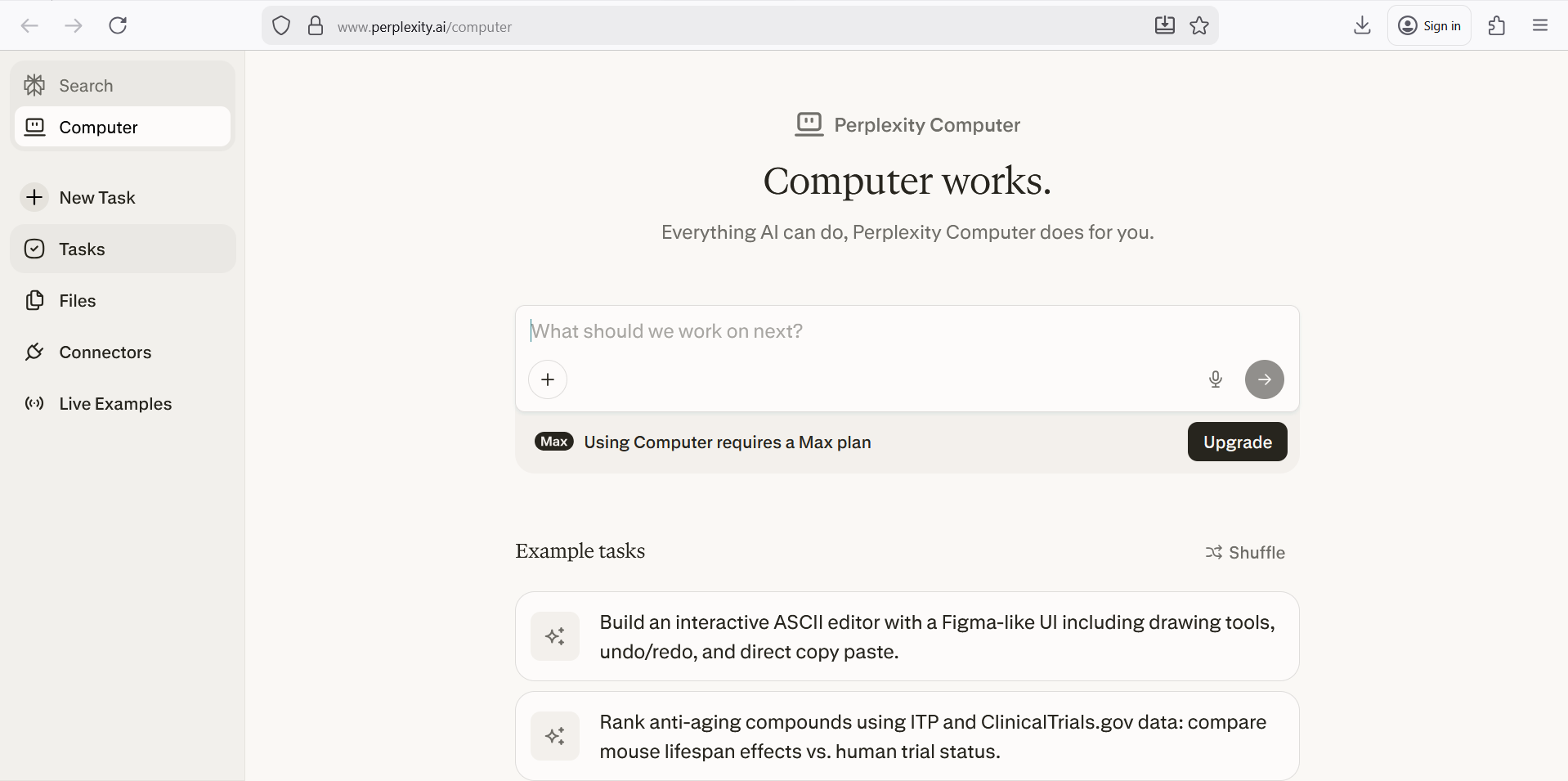
In simple terms, it is like a smart assistant that uses different “brains” (models) to solve a problem. Each brain specializes in something—language understanding, reasoning, coding, search, or summarization—and the system coordinates them to provide better results.
For beginners, think of it as:
- A smart AI system that answers complex queries
- A platform that combines multiple AI technologies
- A reasoning-based computing environment
How It Works?
Perplexity Computer works through a structured pipeline that involves input processing, model selection, reasoning, and output generation.
User Input Processing
The system receives a query (text, command, or instruction) and analyzes its intent using natural language processing techniques.
Task Classification
It determines the type of request:
- Is it a factual question?
- Does it require reasoning?
- Is coding needed?
- Does it require real-time data?
Model Selection
Based on the classification, the system selects the most suitable AI models for the task.
Response Generation
The selected models generate intermediate outputs, which are refined and combined into a final response.
Validation & Optimization
The response is checked for consistency, relevance, and clarity before being delivered to the user.
Multi-Model Orchestration
Multi-model orchestration is the core strength of Perplexity Computer. Instead of depending on a single AI model, it coordinates multiple models to work together efficiently.
Here’s how orchestration helps:
- Specialization: Different models handle different tasks (e.g., one for reasoning, one for coding, one for summarization).
- Fallback Mechanism: If one model fails or produces low confidence output, another model can validate or replace it.
- Parallel Processing: Multiple models can process different parts of the task simultaneously.
- Confidence Scoring: The system evaluates outputs and selects the most reliable result.
This approach improves both performance and reliability compared to traditional single-model systems.
Benefits of Perplexity Computer
Perplexity Computer offers several advantages, especially for beginners exploring AI systems.
- Higher Accuracy: Combining multiple models reduces errors.
- Better Context Understanding: Improves response quality for complex questions.
- Scalability: Easily integrates new models as technology evolves.
- Flexibility: Suitable for research, coding, education, and enterprise use.
- Improved Reliability: Multi-model validation increases trust in responses.
Perplexity Computer represents a modern approach to AI computing by combining multiple models into a single intelligent system. For beginners, it is important to understand that its power lies in orchestration, validation, and model collaboration. As AI continues to evolve, multi-model systems like this will play a major role in building more reliable and intelligent applications.
More info:
