Test Strategy
Test Strategy
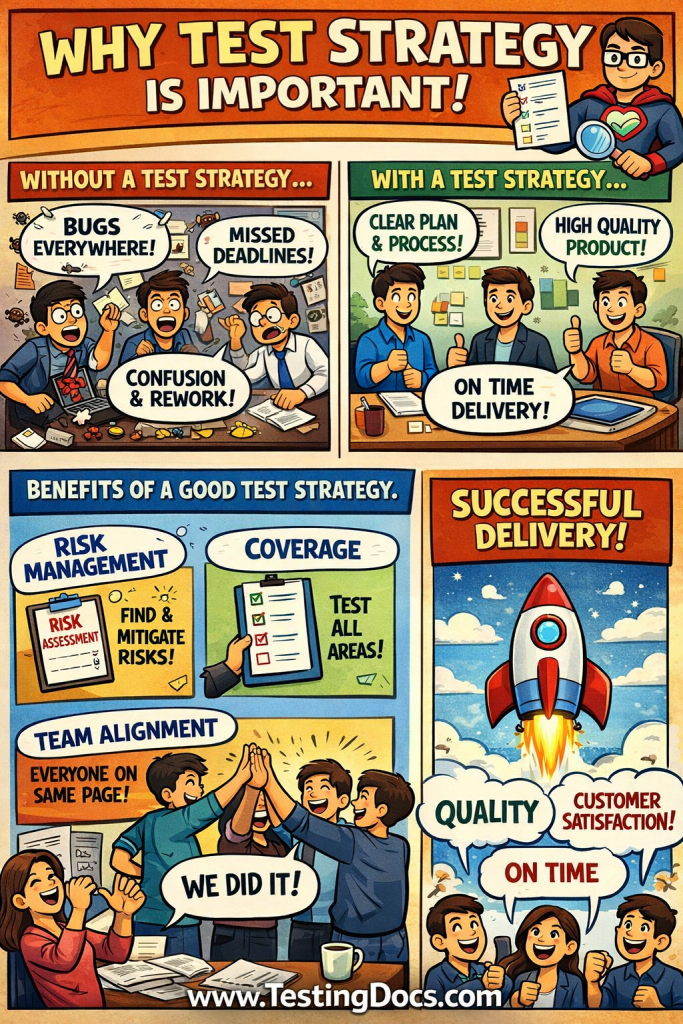
A Test Strategy is a high-level document that defines the overall approach, principles, and direction for testing in a project. It focuses on how testing will be performed to ensure product quality.
Purpose of Test Strategy
- Provide a clear testing approach
- Align team on testing standards and practices
- Ensure quality and complete test coverage
- Define tools, techniques, and responsibilities
Components of Test Strategy
1. Scope & Objectives
Defines what needs to be tested and the goals of testing.
2. Test Levels
- Unit Testing
- Integration Testing
- System Testing
- User Acceptance Testing (UAT)
3. Test Types
- Functional Testing
- Non-functional Testing (Performance, Security, Usability)
4. Test Approach
- Manual Testing
- Automation Testing
- Risk-based Testing
- Exploratory Testing
5. Tools & Frameworks
- Automation tools (e.g., Selenium, Karate)
- Defect tracking tools (e.g., JIRA)
6. Test Environment
Details about hardware, software, and network setup required for testing.
7. Roles & Responsibilities
Defines responsibilities of QA, Developers, and Managers.
8. Entry & Exit Criteria
- Entry Criteria: Conditions to start testing
- Exit Criteria: Conditions to stop testing
9. Risk & Mitigation
Identifies potential risks and strategies to handle them.
10. Reporting & Metrics
- Defect density
- Test coverage
- Pass/Fail rates
Test Strategy vs Test Plan
| Test Strategy | Test Plan | |
|---|---|---|
| Level | High-level document | Detailed document |
| Focus | Approach & principles | Execution & schedule |
| Created by | Project/Program Manager | Test Manager / QA Lead |
| Scope | Project or organization-wide | Release or sprint-specific |
Example
- Automation for regression testing
- Manual testing for exploratory scenarios
- Agile methodology followed
- Defects tracked using JIRA
- CI/CD pipeline for execution
Summary
Test Strategy = “How we will test the product to ensure quality.”