Chaos Engineering
Chaos Engineering
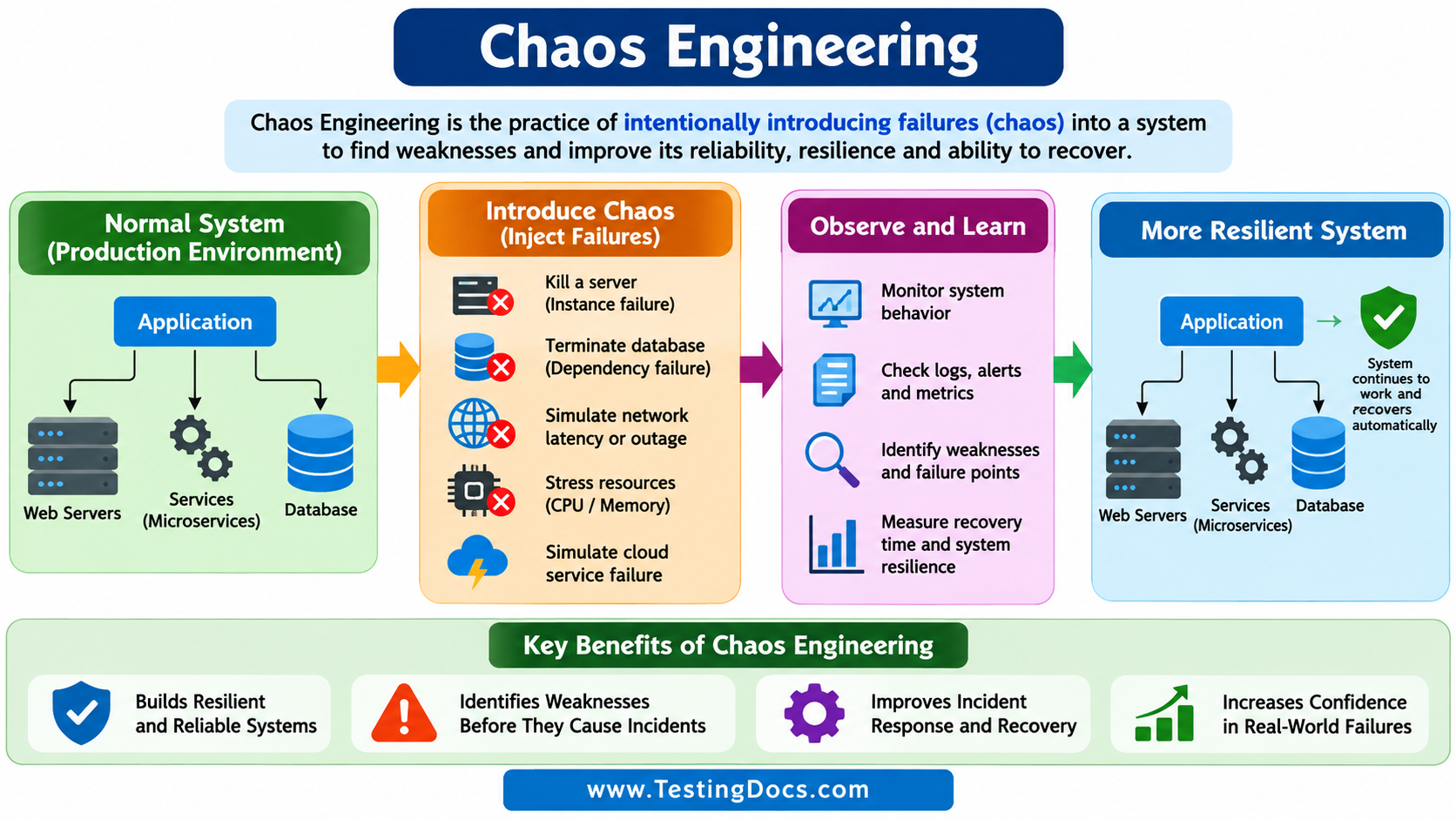
Chaos Engineering is a software engineering practice used to improve the reliability and resilience of applications and infrastructure by intentionally introducing controlled failures into a system.
The basic idea is simple: instead of waiting for a real production failure to discover weaknesses, engineering teams deliberately simulate failures and observe how the system behaves.
What is Chaos Engineering?
Chaos Engineering is the practice of conducting controlled experiments on a system to discover how it behaves under unexpected or difficult conditions.
Modern applications often consist of many interconnected components such as:
- Web servers
- Micro-services
- Databases
- Cloud infrastructure
- APIs
- Message queues
- External services
If one of these components fails, the failure may affect other components. Chaos Engineering helps teams understand these failure scenarios before they become serious incidents.
Chaos Engineering means intentionally breaking parts of a system in a controlled way to make the overall system stronger.
Software systems may work perfectly during normal conditions but behave unexpectedly during failures.
For example, a system may experience problems when:
- A database becomes unavailable.
- A server suddenly crashes.
- Network connectivity becomes slow.
- An API service stops responding.
- A cloud instance is terminated.
- CPU or memory usage becomes extremely high.
Traditional testing usually focuses on expected behavior. Chaos Engineering focuses on unexpected failures and system resilience.
How Chaos Engineering Works
A typical Chaos Engineering experiment follows a simple process:
- Define the expected behavior: Decide how the system should behave during a failure.
- Introduce a controlled failure: For example, stop a server or introduce network latency.
- Observe the system: Monitor application behavior, errors, response times, and recovery.
- Analyze the results: Identify weaknesses or unexpected behavior.
- Improve the system: Fix the weaknesses and repeat the experiment.
Real-World Example
Example: Online Shopping Application
Imagine an online shopping application with the following architecture:
- Web Application
- Payment Service
- Order Service
- Inventory Service
- Database
A customer places an order and expects the payment and order processing to complete successfully.
Now imagine that the Payment Service suddenly becomes unavailable.
The development team may discover the problem only after a real outage occurs. Customers may see errors, payments may fail, and orders may be affected.
The engineering team can intentionally make the Payment Service unavailable in a controlled test environment or carefully selected production experiment.
The team then observes whether:
- The application displays a meaningful error message.
- Orders are prevented from being created incorrectly.
- Payment requests are retried safely.
- Failed transactions are handled correctly.
- Monitoring systems detect the problem.
- Alerts are triggered for the operations team.
- The system recovers automatically when the service becomes available again.
If the experiment reveals that the application crashes when the Payment Service is unavailable, the team can fix the problem before a real outage affects customers.
Chaos Engineering Experiments
Teams can simulate many different types of failures.
| Experiment | Example | What It Tests |
|---|---|---|
| Server Failure | Terminate a server instance | Failover and recovery |
| Network Latency | Add 500 ms network delay | Application behavior under slow networks |
| Service Failure | Stop a microservice | Dependency handling |
| High CPU Usage | Consume excessive CPU resources | System stability under resource pressure |
| Database Failure | Temporarily make the database unavailable | Database failover and error handling |
| Packet Loss | Drop a percentage of network packets | Network resilience |
Benefits of Chaos Engineering
Improves System Reliability
Chaos Engineering helps identify weaknesses that may remain hidden during normal testing. Fixing these weaknesses can make applications more reliable.
Prepares Teams for Real Failures
Teams gain practical knowledge about how their applications behave when components fail.
Identifies Single Points of Failure
A chaos experiment may reveal that an application depends too heavily on a single server, service, or database.
Validates Recovery Mechanisms
Backup systems, fail-over mechanisms, retry logic, circuit breakers, and disaster-recovery procedures can be tested under realistic failure conditions.
Improves Monitoring and Alerting
Chaos experiments can reveal whether monitoring and alerting systems detect failures quickly enough.
Builds Confidence in Cloud and Distributed Systems
Distributed systems have many dependencies and failure scenarios. Chaos Engineering helps teams understand how these systems behave when individual components fail.
Reduces the Impact of Unexpected Outages
Finding and fixing weaknesses before they cause incidents can reduce downtime and improve the customer experience.
Chaos Engineering vs Traditional Testing
| Traditional Testing | Chaos Engineering |
|---|---|
| Focuses mainly on expected behavior | Focuses on unexpected failure conditions |
| Validates functionality | Validates resilience and recovery |
| Often uses predefined test scenarios | Introduces controlled failures |
| Checks whether features work | Checks how the system behaves when things go wrong |
Chaos Engineering Tools
Several tools can be used to perform chaos experiments, including:
- Chaos Monkey – Originally developed by Netflix to test resilience by intentionally disrupting services.
- LitmusChaos – A cloud-native chaos engineering platform commonly used with Kubernetes.
- Chaos Mesh – A chaos engineering platform designed for cloud-native environments and Kubernetes.
Best Practices for Chaos Engineering
- Start with small and controlled experiments.
- Define a clear hypothesis before introducing failure.
- Monitor the system carefully during experiments.
- Use safety mechanisms to limit the blast radius.
- Begin in non-production environments before moving to production.
- Document findings and fix discovered weaknesses.
- Stop an experiment immediately if unexpected impact occurs.
Chaos Engineering helps software teams answer an important question:
“What will happen to our system when something goes wrong?”
Instead of discovering the answer during a real outage, teams can intentionally create controlled failures and learn from them. By continuously testing resilience, organizations can build applications that recover more effectively from failures and provide a more reliable experience to users.
Chaos Engineering is about breaking systems safely so they become stronger when real failures happen.