BI Workflow Overview
BI Workflow Overview
Business Intelligence (BI) is the process of collecting, analyzing, and transforming data into meaningful information
that helps businesses make better decisions. In simple terms, BI helps organizations understand what is happening
in their business by using data.
Companies generate large amounts of data every day — from sales transactions, customer interactions, websites,
marketing campaigns, and more. BI tools and processes turn this raw data into reports, dashboards, and insights
that managers and leaders can use to improve performance.
For example, a company can use BI to answer questions like:
- Which product is selling the most?
- Which marketing campaign generated the highest revenue?
- Why did sales drop last month?
- Which customers are most profitable?
BI Workflow Overview
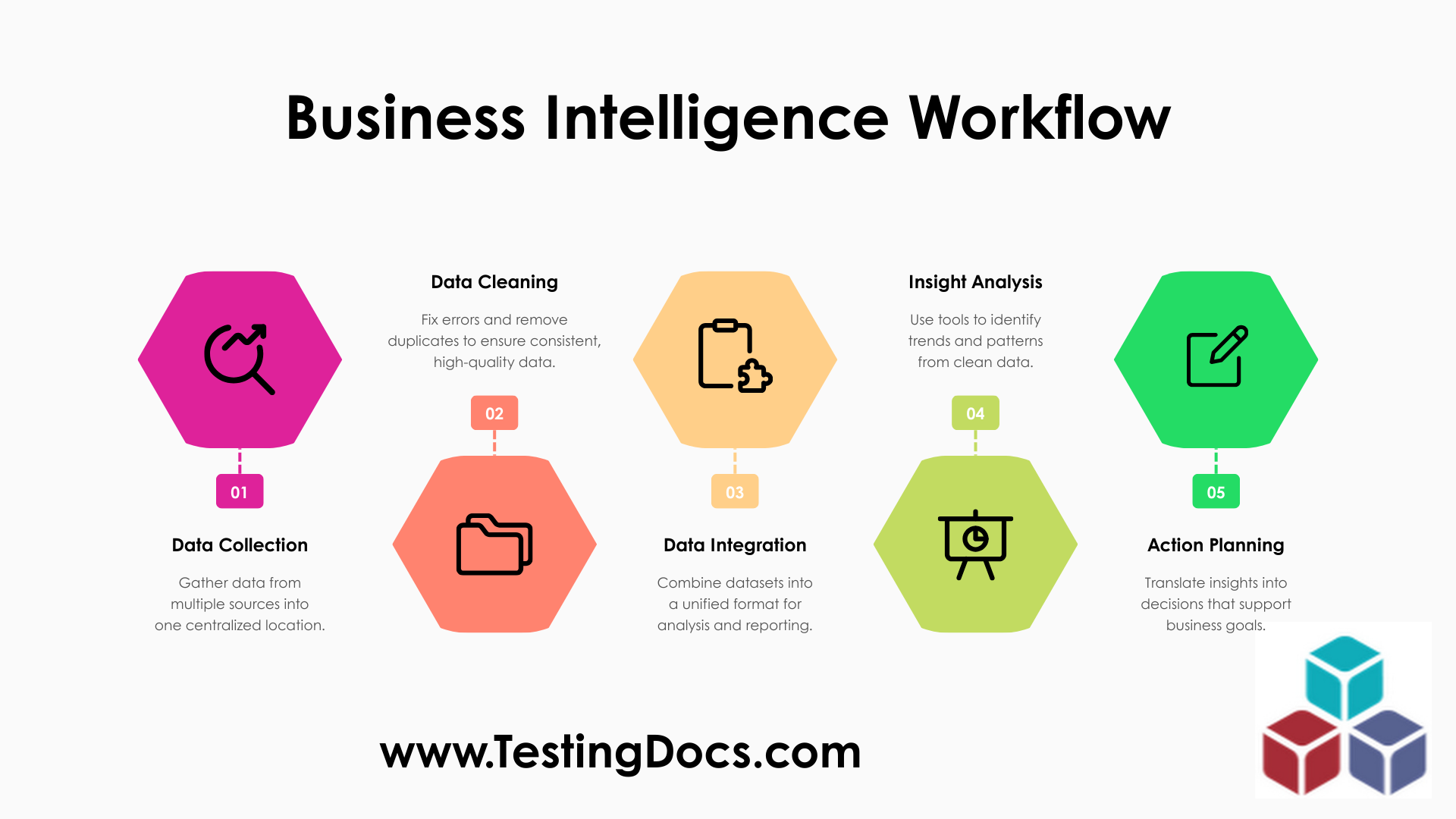
The Business Intelligence workflow is a step-by-step process that transforms raw data into actionable insights.
It typically includes the following phases:
- Data Collection
- Data Cleaning
- Data Integration
- Insight Analysis
- Action Planning
Data Collection
Data collection is the first step in the BI process. In this phase, businesses gather data from various sources.
These sources can be internal or external.
Common data sources include:
- Sales systems
- Customer Relationship Management (CRM) tools
- Websites and mobile apps
- Social media platforms
- Marketing tools
- External market research data
The goal of this stage is to ensure that all relevant data is captured. The more accurate and complete the data,
the better the insights will be later.
Data Cleaning
Raw data is often messy. It may contain errors, missing values, duplicates, or incorrect formats.
Data cleaning (also called data cleansing) is the process of fixing these problems.
This step may include:
- Removing duplicate records
- Correcting spelling or formatting errors
- Filling in missing values
- Removing irrelevant data
- Standardizing units and formats
Clean data ensures accurate analysis. If the data is incorrect, the insights will also be incorrect —
which can lead to poor decision-making.
Data Integration
After cleaning, data from different sources needs to be combined into a single, unified system.
This process is called data integration.
For example, a company might want to combine:
- Sales data from a billing system
- Customer data from a CRM
- Website traffic data from analytics tools
By integrating all this data into a data warehouse or centralized database, businesses get a complete view
of their operations. This helps in identifying patterns and relationships that may not be visible
when data is stored separately.
Insight Analysis
Insight analysis is the stage where data is examined to discover patterns, trends, and meaningful information.
BI tools such as dashboards, reports, charts, and visualizations are commonly used in this phase.
Analysis may include:
- Comparing monthly or yearly performance
- Identifying top-performing products
- Detecting customer behavior patterns
- Forecasting future sales trends
The purpose of this stage is not just to look at numbers, but to understand what those numbers mean
and how they impact business goals.
Action Planning
The final step in the BI workflow is action planning. Insights are valuable only if they lead to informed decisions
and actions.
Based on the analysis, business leaders may decide to:
- Increase marketing budget for high-performing campaigns
- Improve or discontinue low-selling products
- Adjust pricing strategies
- Enhance customer service strategies
This stage transforms insights into real business improvements. It ensures that data-driven decisions
help the company grow and stay competitive.
Business Intelligence is a powerful process that helps organizations make smarter decisions using data.
By following the BI workflow — Data Collection, Data Cleaning, Data Integration, Insight Analysis,
and Action Planning — businesses can turn raw data into meaningful actions.