What is Observability Testing?
What is Observability Testing?
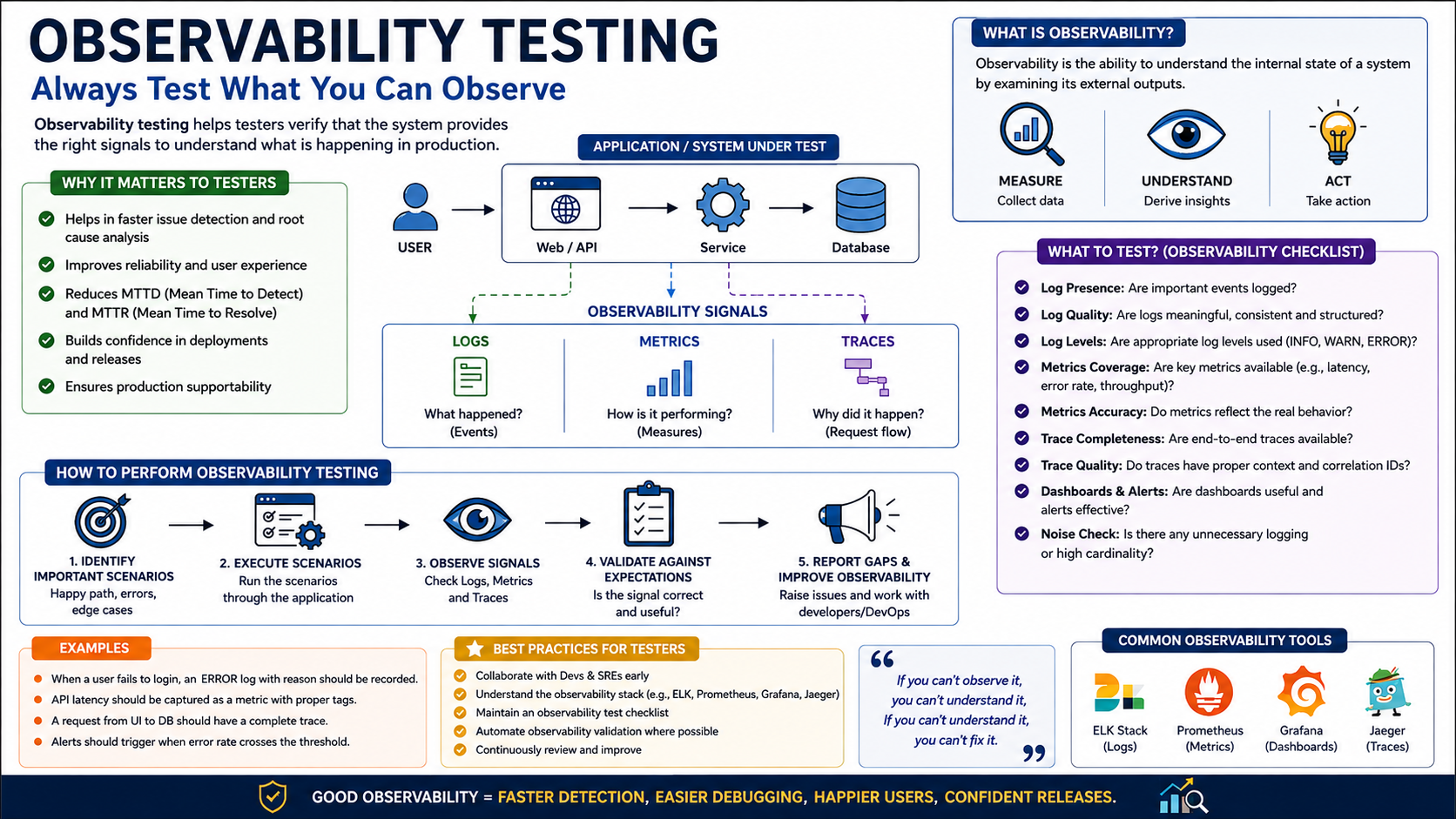
Observability Testing is the practice of testing how effectively we can understand the internal state and behavior of an application by analyzing its logs, metrics, traces, and other telemetry data.
In traditional testing, we mainly ask: “Does the application work correctly?”
In observability testing, we also ask: “Can we understand what happened when something goes wrong?”
Why is Observability Testing Important?
Modern applications are often distributed across multiple services, databases, APIs, queues, and cloud infrastructure. When a failure occurs, simply knowing that a test failed may not be enough.
- Can we identify which service caused the failure?
- Can we determine why the failure occurred?
- Can we trace a request across multiple services?
- Are important errors recorded in the logs?
- Are useful metrics available?
- Can developers and testers quickly troubleshoot the problem?
Three Main Pillars of Observability
- Logs – Record events and errors that occur inside the application.
- Metrics – Provide numerical measurements such as response time, CPU usage, error rate, and request count.
- Traces – Track a request as it travels through different services and components.
Example: Online Shopping Application
Imagine an online shopping application with the following architecture:
Customer → Web Application → Order Service → Payment Service → Database
A tester places an order, but the application displays: “Payment Failed.”
Without Observability Testing
The tester knows only that the payment failed. They may have to manually investigate several services to find the root cause.
With Observability Testing
The tester checks the telemetry data and discovers:
- The request reached the Order Service successfully.
- The Order Service called the Payment Service.
- The Payment Service returned an HTTP 500 error.
- The trace shows that the failure occurred while communicating with the payment gateway.
- The logs contain the corresponding error and transaction/request ID.
- The metrics show an increase in payment failures.
The tester can therefore identify not only that the payment failed, but also where and why it failed.
What Do Testers Check?
| Area | What to Test |
|---|---|
| Logs | Are important events, warnings, and errors logged correctly? |
| Metrics | Are response time, error rate, throughput, and other important metrics captured? |
| Traces | Can a request be followed across multiple services? |
| Correlation IDs | Can logs and traces for the same request be connected? |
| Alerts | Are important failures detected and reported? |
| Debuggability | Does the telemetry provide enough information to troubleshoot failures? |
Simple Definition
Observability Testing = Testing whether an application’s telemetry helps us understand what is happening inside the system.
In short, functional testing tells us “Did it work?”, while observability testing helps answer “What happened, where did it happen, and why did it happen?”