Python Tuple Functions
Python Tuple Functions
Let’s learn Python tuple functions in this tutorial. Python has a sequence type called a Tuple that cannot be modified once created, making it an immutable data structure. Tuples are defined by enclosing elements in parentheses () and can store a sequence of different types of elements.
Python Tuple Functions
Python language also provides various tuple functions, which are as follows:
| Python Tuple Function |
Description |
| len() | This function returns the total number of elements in the tuple. |
| min() | This function returns the smallest element in the tuple. |
| max() | This function returns the largest element in the tuple. |
| sum() |
This function returns the sum of all the elements of the tuple. |
| sort() | This function returns the sorted list of elements of the tuple. |
| all() | This function returns true if all the elements of the tuple are true. |
| any() | This function returns true if any element of the tuple is true. |
| enumerate() | This function returns an enumerate object of the tuple. |
Example
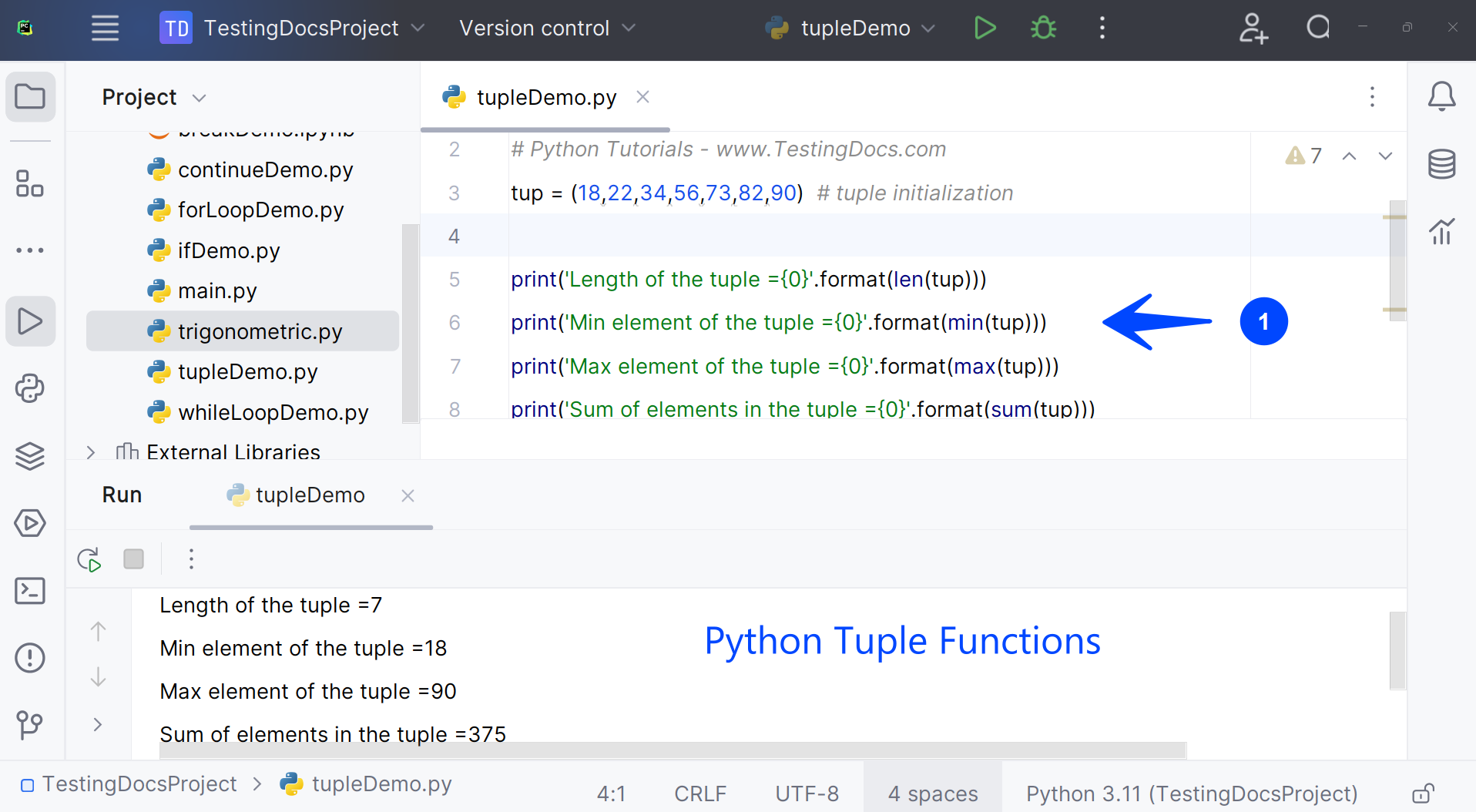
Let’s understand the function with the use of a sample Python program.
# Python program tuple functions
# Python Tutorials - www.TestingDocs.com
tup = (18,22,34,56,73,82,90)  # tuple initialization

print('Length of the tuple ={0}'.format(len(tup)))
print('Min element of the tuple ={0}'.format(min(tup)))
print('Max element of the tuple ={0}'.format(max(tup)))
print('Sum of elements in the tuple ={0}'.format(sum(tup)))
The immutability of tuples results in faster iteration compared to lists. Tuples are a fundamental data type in Python and are extensively used in various applications, particularly where immutability and data integrity are important.
—
Python Tutorials
Python Tutorial on this website can be found at:
https://www.testingdocs.com/python-tutorials/
More information on Python is available at the official website:

