Java Bitwise AND operator
Java Bitwise AND operator
In this tutorial, we will learn about the Java Bitwise AND operator with a simple Java program. The bitwise AND operator produces 1 if the corresponding bits in both operands are 1; otherwise, it produces zero. The (&) is the bitwise AND operation symbol.
Table
The outcomes table with the bitwise AND operator is shown as follows:
| Operand: A | Operand: B | Bitwise AND : A&B |
| 0 | 0 | 0 |
| 0 | 1 | 0 |
| 1 | 0 | 0 |
| 1 | 1 | 1 |
Code
Sample Java program to demo the operator usage.
/*
 * Java Program to demonstrate
 * Bitwise AND Operator.
 * Java Tutorials -- www.TestingDocs.com
 */
public class BitwiseANDDemo {
    public static void main(String args[])
     {
    	  //Declare two variables
          int A = 1;
          int B = 0;
          System.out.println("A & B =: " + (A&B));
          A = 1;
          B = 1;
          System.out.println("A & B =: " + (A&B));
     }
}
Sample output
A & B =: 0
A & B =: 1
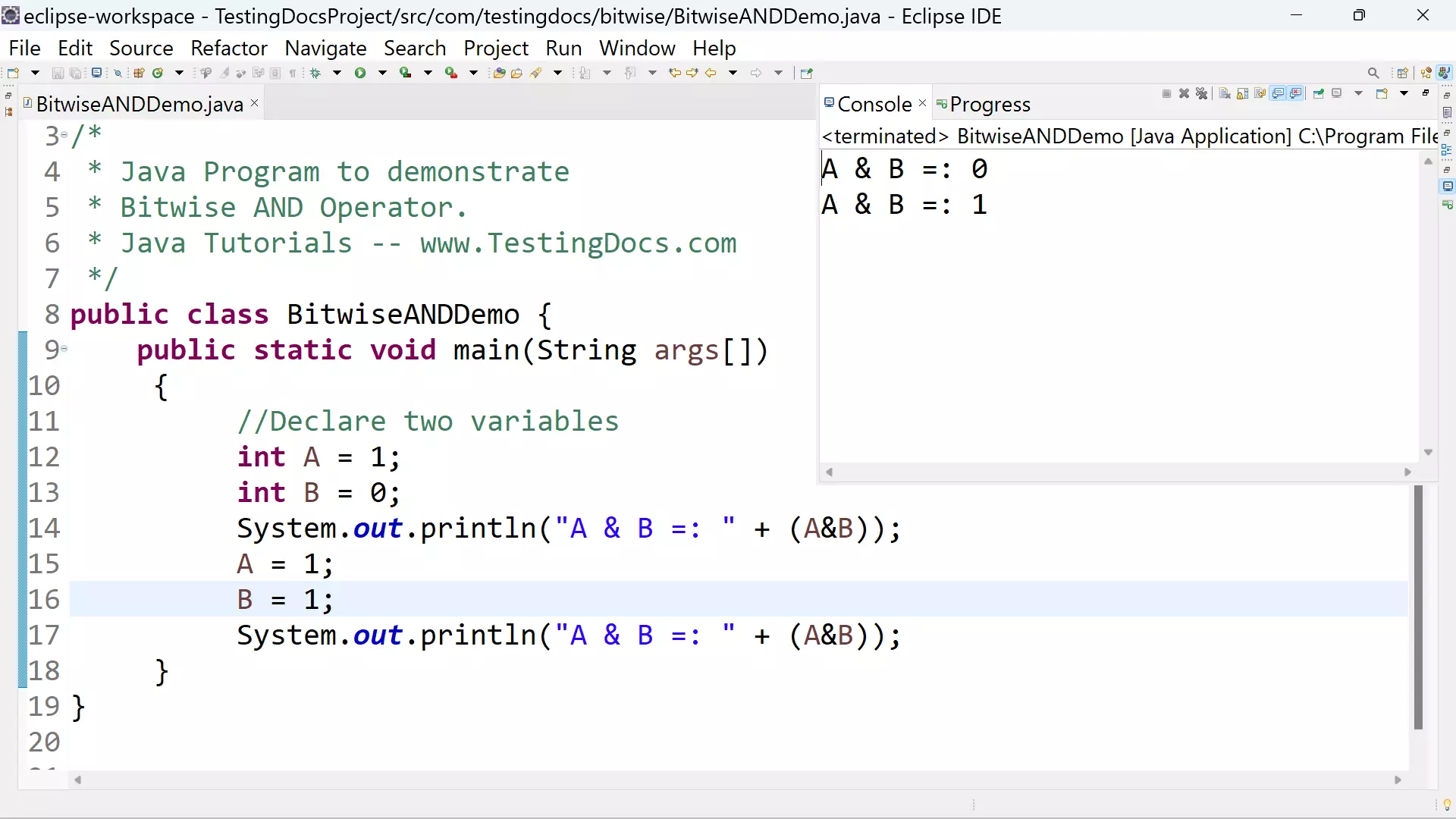
Notice that the result is 1 if the individual bits had a 1 for both the operands A and B.
Exercise
1. The above program displays the two rows of the outcome table. Modify the A and B values to check the other rows of the outcome table.
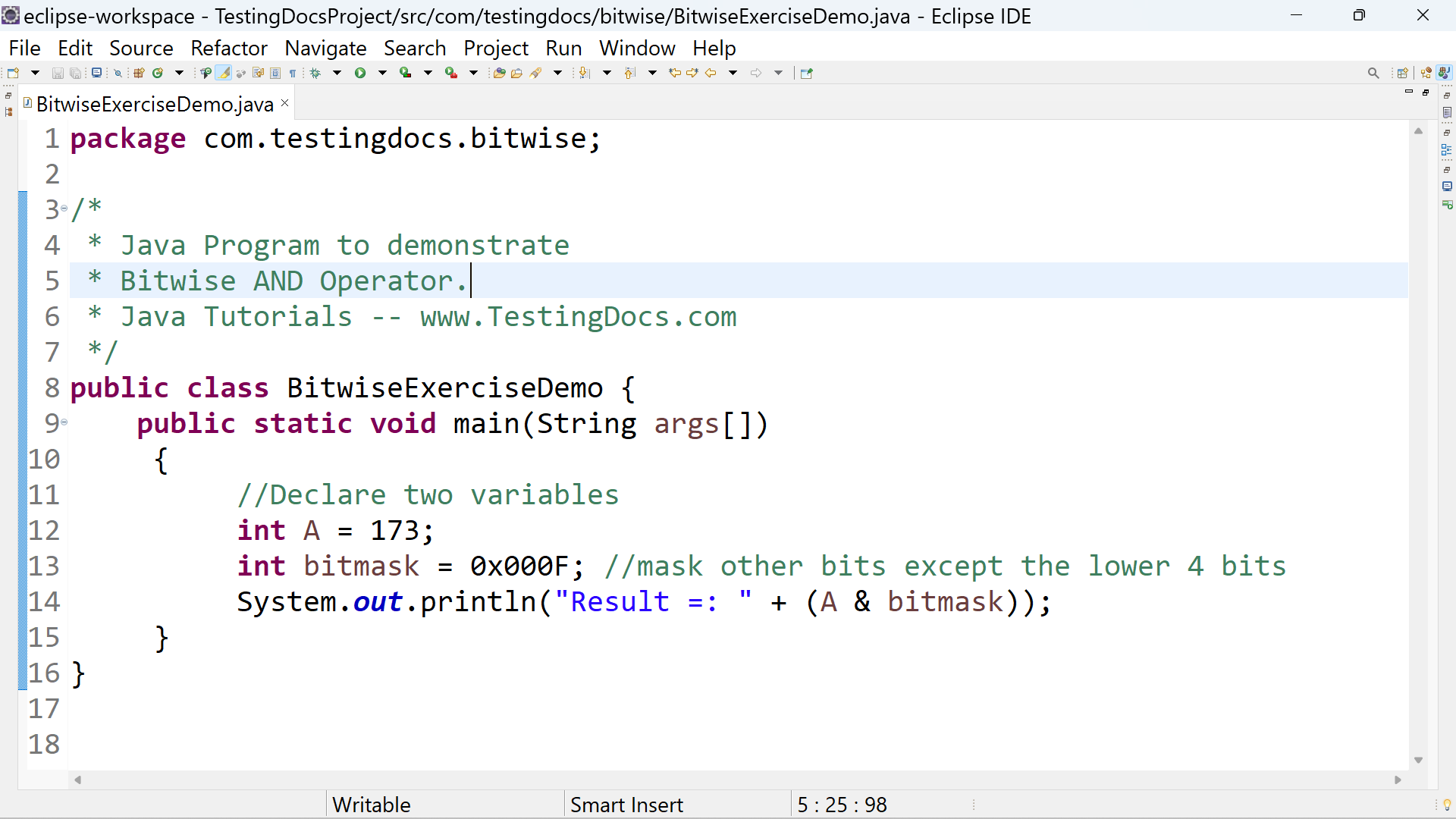
2. Run the following program and check the output. The program masks the bits of the variable A except the lower 4 bits. 0x0F is a hexadecimal number which is equivalent to 15 in the decimal number format.
It represents the lower four bits and translates to the bit pattern 0000 1111.
public class BitwiseExerciseDemo {
    public static void main(String args[])
     {
    	  //Declare two variables
          int A = 173;
          int bitmask = 0x000F; //mask other bits except the lower 4 bits
          System.out.println("Result =: " + (A & bitmask));
     }
}
—
Java Tutorials
Java Tutorial on this website:
https://www.testingdocs.com/java-tutorial/